
 Benny Morgan
 Karla Spencer
Key Takeaway: Elon Musk’s artificial intelligence company, xAI, has officially launched Grokipedia, an AI-powered online encyclopedia designed to rival Wikipedia. The platform went live on October 27, 2025, though its debut was briefly disrupted by technical issues that caused the site to crash within hours of launch. Despite the rocky start, Grokipedia represents one of Musk’s most ambitious attempts yet to reshape the way people access and consume knowledge online.
A New Challenger to Wikipedia
For more than two decades, Wikipedia has been the dominant online encyclopedia, boasting more than 7 million English-language articles and a global community of volunteer editors. Grokipedia, by contrast, entered the scene with 885,279 AI-generated entries at launch. While smaller in scale, Musk has positioned the platform as a direct competitor to Wikipedia, arguing that its AI-first approach will deliver more accurate, timely, and unbiased information.
Announcing the launch on his social media platform X, Musk wrote: “Grokipedia.com version 0.1 is now live. Version 1.0 will be 10X better, but even at 0.1 it’s better than Wikipedia imo.” The statement reflects Musk’s long-standing criticism of Wikipedia, which he has accused of harboring editorial bias, particularly toward left-leaning perspectives.
How Grokipedia Works
Unlike Wikipedia’s crowdsourced model, which relies on thousands of volunteer editors, Grokipedia is powered by xAI’s Grok chatbot. The system continuously generates, verifies, and updates encyclopedia entries using real-time data from multiple sources.
Key features include:
- Dynamic Article Generation: Grok automatically refreshes entries to ensure information remains current.
- Fact-Check Timestamps: Each page displays a declaration that Grok has “fact-checked” the content, along with a timestamp of the most recent verification.
- User Feedback System: While users cannot directly edit entries, they can submit correction requests through an on-screen form. Grok then evaluates these suggestions for accuracy.
- Conversational Search: Visitors can query Grokipedia in natural language, receiving context-aware explanations rather than static fact lists.
This AI-first approach represents a fundamental shift in how knowledge is curated online. Instead of relying on human consensus, Grokipedia emphasizes automated truth-seeking, with Grok synthesizing information from diverse sources to provide what Musk calls “the whole truth and nothing but the truth.”
How to Access Grokpedia
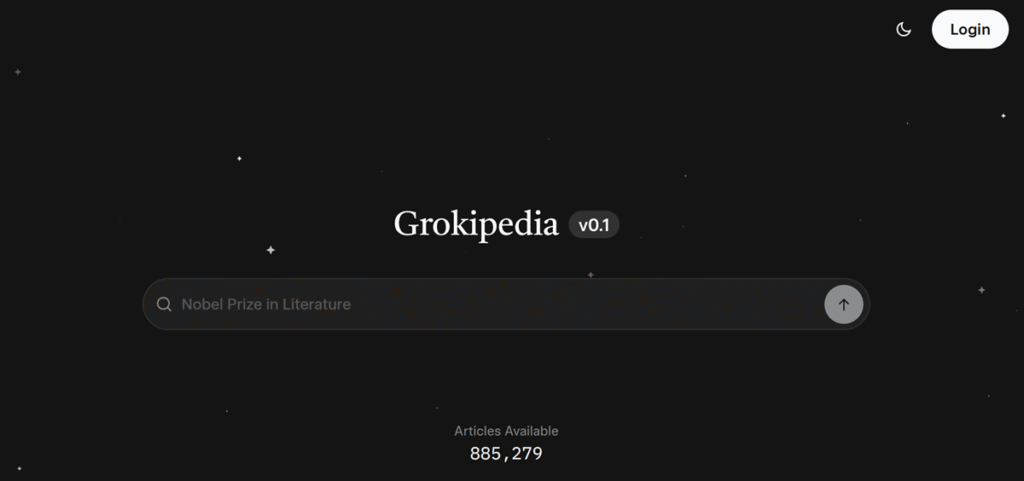
Users can access Grokpedia by visiting the official website at grokpedia.com, which features a minimalist homepage with a search bar for easy navigation. To start using the platform, users log in with their X (formerly Twitter) account credentials, integrating the two platforms for streamlined access.
While Grokpedia is open and free to use, some services related to xAI’s AI assistant Grok 3 require subscriptions to X Premium+ in supported regions. However, Grokpedia itself does not currently require a paid subscription; anyone can freely browse and search its AI-generated content without restrictions.
Launch Day Challenges
The platform’s debut was marked by technical difficulties. Grokipedia crashed shortly after going live on Monday afternoon, leaving users unable to access the site for several hours before it stabilized later that evening. Despite the setback, the platform returned online with approximately 885,279 articles available for public access.
This article count, while substantial, represents only a fraction of Wikipedia’s extensive library. The English version of Wikipedia currently hosts approximately 7 to 8 million human-written articles, making it significantly larger in both scope and depth than its new competitor.
Musk’s Vision and Motivation
Musk’s creation of Grokpedia stems from years of criticism directed at Wikipedia. The tech entrepreneur has repeatedly accused the crowdsourced encyclopedia of harboring editorial bias, particularly toward left-leaning perspectives. In January 2025, he urged followers to “defund Wikipedia until balance is restored”.
“The goal of Grok and Grokipedia.com is the truth, the whole truth and nothing but the truth. We will never be perfect, but we shall nonetheless strive towards that goal”, Musk posted on X, outlining the platform’s philosophical foundation.
When asked about key differences between the platforms, Grok explained: “Grokpedia leverages xAI’s Grok to synthesize knowledge from diverse sources, prioritizing maximum truth-seeking over consensus-driven editing”. This represents a fundamentally different approach to knowledge curation compared to Wikipedia’s community consensus model.
Open Source and Free Access
Like Wikipedia, Grokipedia is free to use and open source. Musk emphasized this point in his launch announcement: “Grokipedia.com is fully open source, so anyone can use it for anything at no cost.”
However, unlike Wikipedia’s decentralized editing model, Grokipedia’s content management is centralized through AI, with human users limited to feedback rather than direct contributions. This hybrid approach may appeal to those who value accuracy and efficiency, but it could also alienate contributors who see Wikipedia’s open-editing model as essential to its success.
The Road Ahead
Musk has promised that Grokipedia’s current version is only the beginning. He has pledged that version 1.0 will be “10X better”, with improvements in content accuracy, scale, and usability.
The platform’s future will depend on several factors:
- Scalability: Can Grokipedia expand its article base to rival Wikipedia’s millions of entries?
- Accuracy: Will AI verification prove more reliable than Wikipedia’s peer review system?
- Trust: Can Grokipedia overcome skepticism about AI-generated content and establish itself as a credible source of knowledge?
- Community Engagement: Without a volunteer editor base, will users feel invested in the platform’s growth?
A Bold Experiment in Knowledge Curation
Grokipedia’s launch marks a bold experiment in AI-powered knowledge management. It reflects Musk’s broader vision of using artificial intelligence to reshape industries, from transportation and space exploration to media and information.
Whether Grokipedia can truly rival Wikipedia remains uncertain. Wikipedia’s strength lies not only in its vast library but also in its community-driven ethos, which has sustained it for over two decades. Grokipedia, by contrast, bets on the power of AI to deliver faster, more accurate, and less biased information.
For now, Grokipedia stands as a provocative alternative—a test case for whether automated systems can match, or even surpass, the reliability of human collaboration in the pursuit of knowledge.
Other Related Post form securedetectives.com
- SpyX Review 2026: Does It Really Keep Kids Safe?
- uMobix vs Eyezy: Which is Best Parental Control Tool?
- Lloyds IT glitch exposes 447,936 customers’ data in banking wake‑up call
- What Is Anthropic’s Claude Code Security And How Does It Work?
- 5 Best Snapchat Monitoring Apps for Parents (2026)
Source: This article is based on information from Gulf News, Fox Business, Indian Express, CNBC, Time, Business Insider, Axios, and other reputable technology news publications reporting and securedetectives research on Grokipedia’s launch.