 Benny Morgan
 Karla Spencer
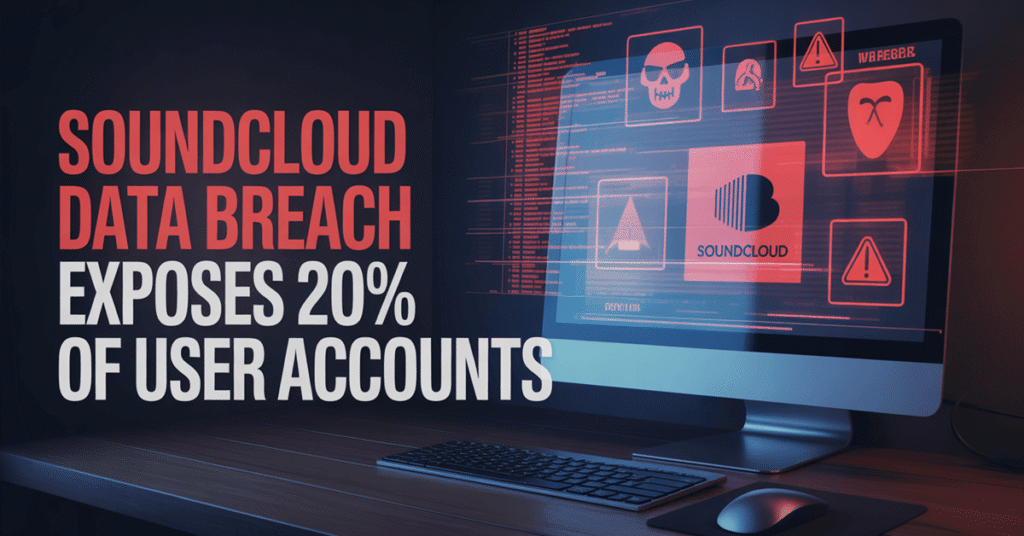
Key Takeaway: SoundCloud revealed a security breach affecting approximately 20% of its user base with email addresses and public profile information compromised by hackers, prompting urgent warnings about phishing attacks.
The Breach: What You Need to Know
On December 15, 2025, SoundCloud officially confirmed a significant cybersecurity incident that had been causing service disruptions for several days. The music streaming platform announced that unauthorized threat actors gained access to an ancillary service dashboard—essentially a back-end administrative control panel—allowing them to successfully exfiltrate email addresses and publicly visible profile information from approximately 20 percent of SoundCloud users. Based on the platform’s total user base, this translates to roughly 28 million affected accounts.
The good news for most users is that the breach remained limited in scope. SoundCloud’s comprehensive investigation confirmed that no sensitive data such as passwords, financial information, or payment details were compromised. The company worked swiftly with third-party cybersecurity experts to contain the threat and eliminate all unauthorized access to its systems.
How the Attack Occurred
SoundCloud detected the unauthorized activity through anomalous behavior within an ancillary service dashboard—a secondary administrative interface that helps manage various platform functions. Rather than compromising core user authentication systems or payment infrastructure, the attackers exploited this peripheral access point, which often receives less scrutiny from security teams than primary systems.
The exact exploitation method remains undisclosed, but cybersecurity experts suggest several likely scenarios: weak authentication credentials, unpatched software vulnerabilities in the dashboard itself, or compromised credentials from someone with legitimate administrative access. Supply chain compromise—where a third-party vendor’s security weakness becomes the entry point—also remains a possibility.
Denial-of-Service Attacks and VPN Disruptions
The incident escalated beyond the initial data breach. Following SoundCloud’s containment efforts, the platform experienced multiple denial-of-service (DDoS) attacks, with two particularly severe incidents temporarily taking the website offline. Mobile and API access remained functional during these attacks, but web users faced significant disruptions.
Adding to user frustration, SoundCloud’s defensive security measures inadvertently caused connectivity issues for users accessing the platform through virtual private networks (VPNs). Users reported receiving “403 Forbidden” error messages when attempting to access SoundCloud via VPN, creating confusion during an already chaotic period. The company has been actively working to resolve these VPN connectivity problems, though it has not provided a specific timeline for full restoration.
Security Enhancements and Investigation Details
In response to the breach, SoundCloud implemented several comprehensive security improvements to prevent similar incidents. These measures include:
- Enhanced Monitoring and Threat Detection: The company deployed advanced monitoring systems to identify suspicious activity faster and detect potential threats in real time.
- Reinforced Identity and Access Controls: SoundCloud reviewed and tightened identity and access management protocols, enforcing stricter authentication requirements and implementing the principle of least privilege across systems.
- Comprehensive System Audit: The platform conducted a thorough security assessment of related systems and ancillary services to identify and remediate similar vulnerabilities.
However, these security configuration changes inadvertently disrupted VPN connectivity for legitimate privacy-conscious users, creating an unintended trade-off between security and accessibility.
Attribution: The ShinyHunters Connection
While SoundCloud did not publicly name the threat actors responsible, cybersecurity researchers and industry sources have attributed the breach to ShinyHunters, a financially motivated cybercriminal group known for large-scale data exfiltration and extortion campaigns. According to reports, ShinyHunters is now actively extorting SoundCloud, demanding payment in exchange for not leaking the stolen data.
ShinyHunters first emerged as a significant threat in 2020 and has built a notorious reputation for high-volume breaches targeting global enterprises. The group shifted tactics in 2024-2025, moving away from traditional ransomware deployment toward pure data extortion—a more profitable and less technically complex approach. More recently, ShinyHunters has partnered with other prominent cybercriminal groups including Scattered Spider and LAPSUS$, forming an extortionist collective that amplifies pressure on victims through coordinated media campaigns and reputation damage.
Industry Context: A Broader Pattern of Platform Breaches
The SoundCloud incident is not an isolated event. The music streaming and digital platform sector has experienced multiple significant breaches recently, highlighting systemic vulnerabilities across the industry. In December 2025 alone, three major platforms disclosed breaches affecting millions of users:
- Mixpanel Analytics Breach: The third-party analytics provider suffered a significant compromise following an SMS phishing attack, exposing customer data including names, email addresses, and user behavior analytics. Confirmed victims include OpenAI, PornHub Premium members, and SoundCloud. ShinyHunters claimed responsibility for this attack as well.
- PornHub Data Exposure: Following the Mixpanel compromise, PornHub disclosed that approximately 200 million analytics records related to Premium member activity were exfiltrated, containing viewing history, timestamps, and location data.
- 700Credit Supply Chain Attack: A separate supply-chain compromise at 700Credit resulted in the exposure of names, addresses, dates of birth, and Social Security numbers for approximately 5.6 million individuals.
These concurrent breaches demonstrate that ancillary services and peripheral systems have become prime targets for sophisticated threat actors, as organizations often allocate security resources toward protecting core systems while leaving supporting services less fortified.
Historical Context: SoundCloud’s Security Track Record
SoundCloud has generally maintained a relatively clean security history compared to some competitors in the music streaming space. Spotify, by comparison, has experienced multiple breaches and security incidents over the past five years. In 2020, Spotify disclosed multiple security incidents including credential-stuffing attacks that compromised over 300,000 accounts, followed by a vulnerability that exposed account registration information to certain business partners.
The current SoundCloud breach represents a significant but atypical security event for the platform, suggesting that no organization—regardless of size or resources—can completely eliminate cyber risk. The attack also underscores how modern platforms must defend increasingly complex ecosystems of integrated services, third-party tools, and ancillary systems.
Implications for Users: What You Should Do
SoundCloud has issued urgent warnings to affected users about the increased risk of follow-up attacks. Users should take several protective measures:
- Monitor for Phishing Attempts: Email addresses obtained in breaches are frequently leveraged in targeted phishing campaigns and credential-stuffing attacks. Remain extremely cautious about unsolicited emails claiming to be from SoundCloud, as cybercriminals frequently exploit breach disclosures to conduct follow-up social engineering attacks.
- Enable Multi-Factor Authentication: If available, activate multi-factor authentication (MFA) on your SoundCloud account to prevent unauthorized access even if your email address becomes part of a phishing campaign.
- Monitor Account Activity: Regularly check your SoundCloud account for suspicious activity or unauthorized changes to your profile, playlists, or listening history.
- Review Connected Applications: Audit any third-party applications that have access to your SoundCloud account and revoke access from services you no longer use.
SoundCloud emphasized its commitment to user protection and transparency, pledging to maintain ongoing communication with affected users and partners as the investigation progresses.
The Broader Security Lesson
The SoundCloud breach offers critical lessons for both large enterprises and individual users about the evolving threat landscape. Ancillary service dashboards, administrative interfaces, analytics tools, and third-party integrations represent the expanding attack surface that modern digital platforms must defend. Cybercriminals have learned to exploit this reality, targeting these peripheral systems precisely because organizations often treat them as lower-priority security concerns compared to core systems.
For organizations, this means extending security protocols beyond primary databases and authentication systems to encompass the entire ecosystem of connected services. For individual users, it reinforces the importance of robust personal cybersecurity practices: strong, unique passwords; multi-factor authentication; vigilant monitoring for phishing attempts; and skepticism toward unsolicited communications.
Sources: TechRadar Pro, BleepingComputer and PCMag